Showing posts with label trainer - training. Show all posts

Friday, December 9, 2011

Flip and Flick


Just Greg and I. We focused on the Cane in close range and confined spaces. We first defined what "close range" and "confined spaces" was in a historic context and then in the modern. We looked at Lang's "Flip" and "Flick," both my interpretation and Craigs. Then Lang and Vigny's bayonet related material. Examined the different grips used in the Lang and Vigny bayonet style material. We also brought in a bit of Cunningham work ("Double Guard"). Did a few drills using modified bayonet (Lang, Vigny, Cunningham) against a knife in a restricted area, then developed a "practice set" of chained techniques and defenses.

Followed this with an inclusion of the defenses against a grab from the "Cane and the Footpad" article along with the logical extensions for left or right use.

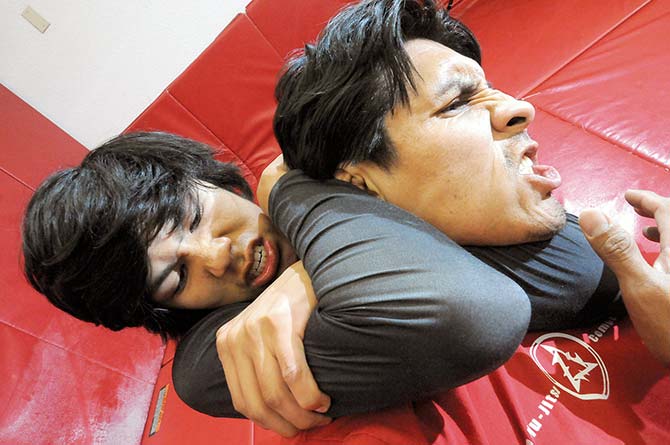
Finally, I taught one blood-choke using the cane which flows sometimes from Lang's "Flip." It's a variant of gyaku.

Thursday, November 10, 2011

Blades -Brawling

Just Greg last night. So, I knew it was going to be a warm, dry, beautiful day so I planned on using what may be the last nice day of the season to do outdoor work, Greatstick and Singlestick/Saber. What I forgot was that Daylight Savings Time borks evening daylight hours in favor of morning. I'd rather have the evening daylight than the morning but the government didn't ask my opinion. Therefore, even though the garage door was open, we worked inside, beneath the cold glare of my fluorescent bulbs.

Brawling – First looked at the Head Butt again. Reviewed the three uses: modern, French Apache attack, and "Scientific Boxing" technique. Spent the most time on the mechanics of the modern technique. Then we went on to Slungshot. Looked at the commonly reported historic carry techniques then worked on deploying from the pocket draw in conjunction with initial attack technique. Next up was pairing the Slungshot with commonly reported history weapons pairings. This includes the knife, coat, and [redacted – I'm saving it as a surprise for the Seminar and book!]

Blades – Next up, BOWIE KNIFE!!!! Huzzah! 

Drill 1: Thrust on inside line and parry to the inside. 
Drill 2: Mandriti style thrust on outside line and parry/back-parry to the outside. 
Drill 3: Combine 1 2, Thrust inside, parry inside, thrust outside, parry outside, lather rinse repeat. Then footwork, parry, and thrust drill with the "swinging bar." 
Finally, SPARRING! WOOT!!!

Wednesday, November 9, 2011

Supreme Grand Master Angel Cabales Exclusive Interview

Grand Master *D*

Grandmaster *D* has over {30} + years of actual training in the field of martial arts. The combat arts that he has studied includes Kajukenbo, Chinese Kempo, Thai Boxing, Tai Chi Chuan, Western Boxing, Kali and the fine art of *Serrada Escrima* as personally taught to him by the late

*Supreme Grand Master Guru Angel O. Cabales* GM *D* Always Looks to be in tip top shape

Regardless of your skill level, style, experience or previous training in the pugilistic weapon or "empty-hand" arts…Grandmaster *D* thoughtfully, and thoroughly guides, and personally teaches you this "beginner to expert" stick-knife and empty-hand training program. The time worn notion that all students must train for 3, 6 or even 10 yrs. is a misnomer, and, is a thing of the past. 

By extracting the essence of Serrada Escrima and combining it with his over {30}+ years of martial arts expertise…You are presented with an "eclectic" modern day style that will give you the decisive edge in the absolute art of streetwise combat.

With Grandmaster *D* "It's all about superior quality of service". 

Serrada Escrima is not only based upon technique, but also, on theories, and concepts that were developed and refined throughout many years by SGM Angel Cabales himself. 

SGM Angel Cabales learned the rudimentary foundation of the Filipino art of escrima from his mentor, 'Dequerdas' SGM Felicisimo Dizon. 

GM *D* began studying Serrada Escrima in 1984 in Stockton, California. With several years of genuine combat experience already underneath his belt, GM *D* knew that after having witnessed SGM Angel Cabales in actual combat action he was indeed a genuine weapons master.

The Late Great Prof. Gilbert Tenio teams up with SGM Angel Cabales at GM *D*s 1984, *Classic Cabales Serrada System of Escrima Seminar* in San Francisco, Ca. GM Angel Cabales once said to GM *D* that his intentions were not to inflict upon him his particular style of martial arts; but rather to demonstrate & to teach him some effective tactics that he could use to make his 'own' style of martial arts even more applicable & even more effective.

SGM Angel Cabales also said to GM *D*, "Any student whose primary focus is to be a carbon copy of his teacher is doing themselves a great disservice. No one can be exactly like the teacher and still retain their own personal identity."

In essence, the 'Cabales Serrada System of Escrima' was designed as a method of personal self-discovery & for self-transformation of the soul. In this hands-on learning system, SGM Cabales called the highest level of martial arts attainment " presence of mind " or "spontaneous intelligent reaction". Around 1986-87, GM *D* arranged & introduced GM Gura Graciela Casillas to SGM Angel Cabales where she began her transformative stages of training within the field of Cabales Serrada Escrima

"When a person is seriously engaged in close-quarter combat, there is no time for thinking, feeling, choosing or judging what is occurring from moment-to-moment" SGM Angel Cabales

Here's how SGM Angel Cabales put it:

On June 3, 1990, GM *D* traveled to SGM Angel Cabales' home in order to conduct a very special interview on him. Although GM *D* had spoken to SGM Cabales many times about his style of fighting, he was always reluctant to ask him about his death matches. SGM Angel Cabales told GM *D* that escrima death matches were an integral part of the ancient warrior code & traditions of the Philippines.

"To willfully test one's skills in an actual match to the death is the ultimate test of true fighting skill and indomitable courage".

SGM Angel Cabales

SGM Angel Cabales added, " Whenever you are engaged in mortal combat you must forget about all of the antics of your opponent. One must not worry about things like how big or strong or how great your opponent's reputation or image is. One must remain calm & cool, but as alert as possible and strike the enemy down with certainty, accuracy, and with overwhelming pinpointed, and strategic execution of overriding power."

SGM Angel Cabales insisted that in order to survive in any life or death encounter, you must bypass all negative and positive conflictualities. Any type of conflictuality constricts the natural flow or " presence of mind of a person." 

Freezing in the midst of a life or death encounter can be very fatal. It is only in a natural state of mind that one can effectively defend himself against myriad of attacks. SGM Angel Cabales taught GM *D* that obtaining high levels of rank or degrees should never be the primary focus of a martial arts aspirant. Instead, a practitioner should focus upon the fundamentals & upon the metaphysical ingredients that lie behind all external formulas for combat fighting. 

According to SGM Angel Cabales, no level of rank could ever equate with the raw courage and skill that is latent within the hearts, bodies, and the minds of every human being. A real warrior works from a position of practicality, and begins the process of becoming a master craftsman by using whatever personality & circumstances he/she is in at the time.

To SGM Angel Cabales, befriending and assisting a person with the elevation of their mind was his greatest and highest achievement award within his lifetime. The 'Cabales Serrada System of Escrima' was designed for thinkers, and for all those who are seeking a supreme martial arts type of lifestyle. 

The art of Serrada Escrima as developed by SGM Angel Cabales entails many aspects of the art of combat.

"In order to make my art of Serrada Escrima serve the present time, we only have to assemble or reassemble my art into its fullest dimensions scientifically, and then my students have to bring to life my art of Serrada Escrima, and then make it there own." SGM Angel Cabales 

Supreme Grand Master Guru Angel O. Cabales

{1917-1991}SGM Angel Cabales stated that his style of fighting could not fail him in any combative encounter. In SGM Angel Cabales' mind his art could never fail him because he always thought in a completely positivist way when it came to close-quarter-combat-fighting. SGM Angel Cabales was not afraid to engage in actual hand-to-hand or weapon-to-weapon encounters.

The Serrada System of Escrima as taught by SGM Angel Cabales was very people oriented. SGM Cabales was not only the first escrimador master to open a commercial escrima academy in America in 1966, but also! like the legendary Bruce Lee; he was amongst one of the first Filipino masters to teach outside of his race.

A good example of this are the top three African American master graduate students that Cabales personally taught escrima to; Professor Sultan Uddin, Master Guru Jerry Preciado, and Grand Master *D*. (l-to-r) GM Jim Mather, SGM Angel Cabales, Grand Master *D* & Professor *Sultan Uddin* (l-to-r) Co-Founder of 'Angel's Disciples' Serrada Escrima Master/ Jerry Preciado & Grand Master *D*

Finally, Angel Cabales believed in the eternal goodness of man. Even when the usurers were closing in on him, he still had faith in his; 'Serrada System of Escrima'. After more than {27} years of practicing and promoting the Serrada Escrima System of martial arts worldwide; GM *D* still continues to discover hidden clues & further meaning that has unearthed some of the deepest secrets of the "Angel Cabales Serrada System of Escrima".

It's these energy-releasing secrets that continue to propel GM *D* upon an " Endless Journey " of self-discovery & further development within the area of close quarter combat.

In an interview in early 1990, just prior to SGM Angel Cabales' death, GM *D* asked the 'Supreme Grand Master' who he felt are some of his top Serrada Escrima graduate student(s). In a proud, and in a jubilant voice, he said;

"All of my students are my top students".

That's how SGM Angel Cabales truly thought, he was always fair & equitable in regards to giving recognition to all of his graduate students.

2007, Grand Master *D* had the distinct pleasure of meeting in person in Augsburg, Germany, one of Ving Tsun Kung Fu's best fighting master's. Master/Guru Sifu Muammer is probally one of the least known of Grand Master Leung Ting's graduate master students. Additionally! Master Muammer has mastered & studied extensively within GM Rene Latosa's Escrima system.

Note: Grand  Master Rene Latosa is a former Serrada Escrima graduate instructor under the late *Supreme Grand Master* Angel Cabales.

GM Rene Latosa received the fundamental's of the combat art of Serrada Escrima directly from SGM Angel Cabales, which in turn greatly aided him when he first introduced his rendition of the art of Serrada Escrima known as 'PMAS' all across Europe.

{1983} Escrima Grand Master Rene Latosa Makes a Special Guest Appearance at GM *D*s "Kali/Jeet Kune Do" Seminar featuring Maha Guru Ted Lucaylucay & Guro Dan Inosanto (l-to-r) Guro Dan Inosanto & GM *D*/1980 Cleveland, Ohio "Kali/Jeet Kune do Workshop"

Ving Tsun/ Escrima Expert Master Guru/Sifu Muammer Grand Master *D* had the distinct pleasure of being one of the first of the late Grand Master Angel Cabales' graduate students to formally introduce the "Serrada System of Escrima" directly to Master Guru/Sifu Muammer at his academy in Augsburg, Germany.

THE IMMACULATE SGM YIP MAN

Grand Master *D* Formally Introduces Serrada Escrima to Master Guru/Sifu Muammer in Germany {l-to-r} Grand Master *D* Prepares to Utilize a Serrada Escrima Cross Block {l-to-r} Master Guru/Sifu Muammer & GM *D* Indeed the fine art of 'Serrada Escrima' along with the illustrious legacy of the "Father of Escrima in America" has crossed over to various shore's all over the world. "Long Live the art of Supreme Grand Master Angel Cabales" THE GM *D* SGM ANGEL CABALES ALLIANCE FORMED IN{1984}

Friday, October 14, 2011

Italian Knife Fighting System?

Has anyone ever heard of this instructor and knife fighting system?

Master Gilberto Pauciullo and Northern Italian Piedmont (?) knife fighting system.

I have been lurking for a long time,and people who know me, like Ken, are aware that I research South American Fighting systems like Garrote and now in Colombia Grima. But another aspect of my research has to do with my Italian heritage, on my fathers side. So for a long time now I have been looking into Italian traditions of Knife and Stick fighting. There are quite a few that are still alive and kept that way by old Masters. The only problem is a certain veil of secrecy maintained by several knife and stick traditions, especially the Sicilian ones. And yes, they exist,they are not reconstructed thru old manuals, the only problem is getting in. Look up BASTONE SICILIANO or COLTELLO SICILIANO and you will get some answers.

Tuesday, October 11, 2011

COMBAT AGAINST MULTIPLE OPPONENTS

Here's some more info on my newest book, which happens to be on one of my most beloved topics: 

Combat in Outnumbered Scenarios: The origin of Historical Fencing.
... 
In this book I cover the fundamentals of combat against multiple opponents both with long double hand weapons (staff) and short single hand weapons (baton).

The main topics are:

- Combat strategy against multiple opponents,
- Principles of engagement,
- Principles and usefulness of active and reactive behavior,
- Technique for distance optimization,
- In motion sweeping parrying technique,
- Scenarios specific of baton due to its shorter length and single hand manipulation,
- Tactical decision making during combat.

The book has one additional chapter in which I cover the historical evolution of combat technique, more specifically parrying technique, presenting why and for what purpose different parrying techniques were created over time, hoping that these contents contribute not only for a better understanding of Martial Art's history but also improve combat strategy.

The book costs 19,95 dollars and is available at www.pretomartialarts.com, as well as on www.amazon.com

More information can be found on www.pretomartialarts.com and http://bf3c2baf.linkbucks.com

Although the Portuguese version of my website is still under construction, all my books are available in both languages.

Wednesday, September 28, 2011

A Weekend of Iberian Swordplay at Gallowglass Academy

I can't speak to the Destreza material, but I've taken several classes with Eric and Puck at WMAWs in 2007, 2009 and 2011 on the montante, the Iberian greatsword that Allen references.

For those who aren't familiar with it, it's a fascinating weapon and style, IMHO. The primary sources are predominantly centered on tactics, not techniques, so while Eric, Puck, Steve Hicks and others have had to work hard to clarify the techniques involved, the scenarios provided in the sources give us a level of insight into the weapon that we have for few other historical weapons.

For example, there are combinations for fighting in an alleyway that's so narrow you can't swing the sword, combos for use in streets that are *just* wide enough to let you swing the sword, and scenarios for guarding a noble lady, for breaking up a fight between fencers, for fighting on the central walkway of a sailing galley, and more.

Given all the source material available, I have no doubt that Eric could easily fill a day with interesting stuff.

I'm definitely planning on going!

I discussed with Maestro Puck Curtis at WMAW having him come out to do a seminar at Gallowglass Academy (25 miles from Rockford, IL and 90 miles from Chicago) next year. Based on our preliminary discussions we are currently looking at doing a two day event on either April 21 - 22 or 28 - 29, 2012.

Maestro Curtis has suggested he do a one day Destreza seminar with sidesword, rapier or longsword and then Maestro Eric Meyers do a one day seminar on Iberian great sword. This will necessitate we get at least 20 students at close to $100 each for the weekend. I am looking to get feedback to see if we can get enough interest in the seminar to let them know to plan on coming out.

So please talk amongst yourselves and any interested students or friends and get me feedback ASAP so I can let Maestri Curtis and Meyers know what is going on.

Saturday, September 10, 2011

Hsing-I Five Elements with Luo De Xiu


He began with some basic thoughts, and showed how the 5 elements become the 12 animals. Tiger is double Pi Chuan, Monkey is Pi Chuan retreating, Dragon is Pi Chuan dropping and splitting. Horse is a reverse Tsuan Chuan, Pao Chuan becomes Chicken and a bunch of others. He always says that each element can be used in numerous ways, big, small, forward and back.

We worked on Pi Chuan most of the time, getting that sense of hefting a big rock rather than snappy forceful moves. He likes to move slow and smoothly, working on making the Mind more aware and dense in the space around you instead of rushing through the forms with crisp fast movements. This slower training allows you more options and adaptations in combat as he demonstrated.


We did a bunch of Tsuan Chuan drills, breaking down the form. We worked on dropping the elbow to get your power under the opponent. Beng Chuan was next and we did a lot of striking low and high in various ways with heavy, clamping down strikes. 


We only had a few minutes at the end for Pao and Heng, so we did a few techniques to wrap it up.


We had a two-day-eight-hours-a-day intensive with Wang Fulai and Huang Shuchun in Milan, earlier in May, and I got (re)introduced to xingyiquan by Master Huang (I had always disregarded it, in favour of tjq, which I now realise was kind of dumb on my part).

As I have been focussing on piquan training ever since, I would like to ask you - how is the elbow of the retreating arm positioned at the end of Luo's piquan? In Wang Shujin's we keep it wide, pointing straight out at 90° from the body... which feels strange in the beginning, but then creates a simultaneous lifting and pressing which I find great for strength development. Quite different from the smooth strength you get in tjq, I'd say, but excellent nonetheless.

Did you find the same kind of work in Luo De Xiu's xingyiquan?

In Luo's version I think we keep the back elbow closer to the body, but the elbow still pulls a bit away from the body. His grandteacher was a good friend of Wang Shu Jin so their systems aren't too far apart.
Cool that you got to train with Huang Shuchun, that's awesome! Always wanted to take his class. Please write more if you feel up for it.


Masters Wang Fulai and Huang Shuchun came to Milan during the second week of May. They taught a week long evening course at Cheng Ming Europe in Sesto S. Giovanni (Milan), which unfortunately I had to miss - but I was told they split the huge Cheng Ming program over the week and dedicated each day to a single component (the three Zhan Zhuang sequences, taijiquan, tui she and you shou, xingyiquan, baguazhang, weapons... it's really immense!). On Saturday 14 and Sunday 15 May they then held their intensive seminar.

Saturday was xingyiquan day, open mainly to Cheng Ming members form Europe (we had people from all over Italy, but also from France and Switzerland, and an Inner-door disciple all the way from Australia! And that itself, the international flavor, the chance to practice with different people of different backgrounds, was worth the price of the event!).

SO - xingyiquan. The class was split into two groups, with Master Wang Fulai teaching a short stick form to intermediate to advanced students, while Master Huang Shuchun went over Wuxing quan with beginners. I stuck with her, of course, since, after being exposed to t, I had neglected xingyi in favor of taijiquan. As you may know, Master Huang Shuchun is the best female students of Wang Shujin (some would say his best bagua person all round) and she is one of the few to have been given full transmission of his curriculum. Personally I favor her technique one Wang Fulai - she is more minutely precise in every detail and aspect of the art, and a great teacher for details.

She began by showing piquan - splitting (ahah! sorry - lame joke) it into five steps:

1. From a stand still, hands, fist closed, called back;
2. The fists "resting" to the sides, they are raised about ribcage level (somewhere midway between hip and pectorals);
3. then the step, and the whole body is propelled forward by the simultaneous action of the two legs, two fists extended, the arm corresponding to the front leg thrust forward in a punch, the other arm "resting" (but there is a thrusting feeling to it) on the inside of the elbow;
4. From the end of the previous movement, here there is a sort of "coiling back" of the whole body on itself, beginning with the advanced forearm;
5. The splitting - santishi.

Santishi is very interesting. Since we were working out in a basketball court, Master Huang used to lines on the ground to explain feet and legs alignment - it's the outer edge of the front foot that should be parallel to the line on the floor, while the knees fall naturally inwards and the body faces forward. This creates a sort of spiraling/coiling of the whole body even while doing santishi-zhan zhuang, as the result of two opposing torsions. The back arm is, as I told you, very open to the side, with the elbow pointing directly away from the body, which causes the back, chest, heart and lungs to open naturally (and it had very good effects on my asthma, by the way!). Then there is a feeling of sinking with the backward hand, while the front hand (very frontal, with the upper arm extended straight away from the body and the elbow bent at about 50°) "pushing" forward. The fingers of a front hand should have a feeling of grabbing/grasping something - I was told this develops hand strength in qin na.

The same coiling/twisting/spiralling could be found in moving through piquant: when the front foot moves forward, and the whole body follows, in mid-step the two legs are twisting in one direction, 45°, while the arms are extended towards the front - in the opposite direction. This adds a sort of springing power to the movement, a feeling of being drawn inexorably forward while retaining control over your body.

The rest of the five fists is pretty much what one regularly sees in other styles, though the same twisting/coiling from piquan appears in very other techniques and movements develop a way of entering into the front line of the opponent at a slight off angle - you might be moving forward, but it is not exactly the same "forwardness" I was used to - say - in karate or boxing or full.

Master Huang also explained about the health benefits of every technique of xingyiquan - though her English was too poor, of course she has no Italian and the interpreter was working with Wang Fulai. I tried to act as translator from Chinese, which was OK (or almost so) until she got on the nuances of the meridians, the spiraling jin and the rising and falling of power - a bit too much for a self-taught! But what was clear is that the body mechanics in each movement are beneficial to both health and fighting: the arm position in piquant-santishi, or example, opens heart and lungs, while the beginning movement, with the arms twisting up wide to the sides, then falling down and twisting back - it creates an internal "widening of space" and following "closing" in the heart region, which massages the heart, and decompresses it. After seven hours of this, you could feel a warm wave rushing through the "yang" parts of the body, especially arms and trunk and legs, and a sense of strength and well being.

...but I have already written a fairly long essay - sorry, there would be so much more to tell! - If you think it worthwhile, I'll try and write some more on the second day - Taijiquan and martial applications.

We spent today working on some of the 12 animals of the Hsing-I system.

As always Luo Laoshi pointed out that the five elements are the important part and that the animals are for improving your range of motion and adding new ideas. But the five elements are all the component parts of the animals. For instance Dragon, Tiger and Monkey are all mostly Pi Chuan, but Hawk is Heng Chuan, and so is Bear. But all of them have a variety of elemental ingredients.

We did tons of fighting drills, techniques and power training. Can't describe them, but they were the usual variety of openings, controls, slaps, strikes, throws and locks all with an eye for quick fight stopping.
He showed how Hsing-I tries to get your opponent to close up, cover up and retreat. Hsing-I power is great for drilling into and cracking open someone stiff and brittle. Make them shrink their space so you can smash into it more effectively.

Heng Chuan is the mother palm because it is drilling, in all it's dimensions. All the 5 elements are just variations of Heng Chuans drilling and twisting actions. This motion is at the heart of all Hsing-I attacks and defenses.

We did the 5 Tiger Forms, each version of Tiger corresponds to one of the 5 elements. Raking the face, ripping the body and squashing the organs were taught. We did a lot of chasing drills for when they try to escape.

We did Bear and Eagle. Bear is heavy swatting and shaking power. We did lots of shoulder strokes and body checks to rattle their whole structure. Eagle is gripping and crashing down on top of them.

We did a long version of Hawk, incorporating Pi Chuan, Pao Chan, Tsuan Chuan, Heng Chuan and Beng Chuan in that order. A cool form that combines some great moves together. Smash down on him, then burst up from underneath. Hook, catch and strike the body.

Luo packs so much into these things that I can't delineate the 35 or more techniques we did today, all with variations. Plus all the principles and body movement drills. I only hope some of it will remain in my subconscious.

Then we did Monkey, lots of slapping catches, sticking to them, chasing them with jumping slaps, and body checks and flying knees. Vicious but playful.

Basically is was Hsing-I overload and we'll get to do more tomorrow.


Saturday, September 3, 2011

the navaja trainers

Matt and I today.


No session last week or even midweek. had a run in with a hornet and found out I am more allergic than I thought I was. Matt had eye surgery a few weeks ago and finally got the ok to get punched in the head...


2 rounds shadow boxing
4 rounds boxing
1 round savate


On with the jackets for some sambo...

2 rounds grip work
2 rounds freestyle sambo
1 round par terre.


Sambo is fun but more than a little rough, often we are turned upside down during a throw or groundwork, stomach acid has no respect for the authority of gravity (what does that mean? I don't know) we call it sambo reflux. Often heartburn follows a good training session. I also suffer from something I call sambo amnesia. I have the hardest time remembering how we get to the ground even if I am the guy doing the throwing. Often I have to ask my training partner what just happened.

Strange but like I said, fun. Out came the navaja trainers. After a quick refresher on some basics we spent some time throwing a viaje or three. A viaje is a low line thrust to the belly, there are several different methods for doing this. We focused on a fully committed attack sometimes with a standard grip, some times with a Mediterranean grip(edge up). We also worked our cambios (hand switches)and switched from a viaje to a desjarretazo or ripping attack. We ended with a review of technique using the faja or sash, the finale being a bout using the faja and navaja in conjunction.


We then went over some of Dempsey's basics for power generation, this time we applied them to elbow strikes...brutal! We also hit the shovel hook, both to the head and to the body. My favorite punch. Last we applied Dempsey's mechanics to holding and hitting, the shoulder whirl is a thing of beauty. Good session, felt good to get to hitting people again.


So what is happening in your training sessions? I really want to steal some of what you do.